Series Resistor Calculator
Add up resistors connected in series. Enter each value in Ω, kΩ or MΩ and get the total resistance instantly.
How to use the series resistor calculator
Type in each resistor value and choose its unit. Add rows with Add resistor or remove them with the × button. The total is shown straight away.
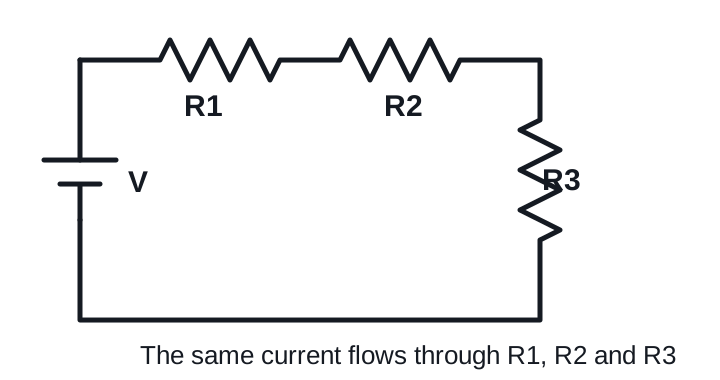
Series resistance formula
Resistors in series simply add up:
Rtotal = R1 + R2 + R3 + …
Make sure every value is in the same unit before adding. The calculator converts for you, so 1 kΩ + 470 Ω is correctly shown as 1.47 kΩ.
Worked examples
- 1 kΩ + 2.2 kΩ + 4.7 kΩ = 7.9 kΩ
- 330 Ω + 330 Ω = 660 Ω, close to the standard 680 Ω value
- 1 MΩ + 470 kΩ = 1.47 MΩ
What series resistors do in a circuit
- The current is the same everywhere. With one path, every resistor carries the same current, worked out with Ohm’s law as I = V / Rtotal.
- The voltage is shared. Each resistor drops a share of the supply in proportion to its value. The voltage drop calculator shows the drop across every resistor.
- The total is always bigger than the largest resistor.
- Tolerances add up too. Two ±5% resistors in series are still ±5% as a pair, but the error in ohms is the sum of both.
Why put resistors in series?
The most common reason is to reach a value you do not have: 2 × 4.7 kΩ gives 9.4 kΩ, and 10 kΩ + 2.2 kΩ gives 12.2 kΩ, close to the standard 12 kΩ. Series strings also spread voltage and heat. High-voltage circuits use several resistors in series so that no single part sees more voltage than it is rated for, and a voltage divider is simply two resistors in series with an output taken from the middle.
To combine resistors in parallel instead, use the parallel resistor calculator.
Frequently asked questions
Do resistors in series have the same current?
Yes. There is only one path, so the same current flows through every resistor in the string.
Do resistors in series have the same voltage?
Only if they have the same value. Otherwise the larger resistor drops more of the voltage.
Does the order of series resistors matter?
Not for the total resistance or the current. The order only changes the voltage measured at each point between them.
More calculators
-
Resistor Color Code Calculator
Decode 3, 4, 5 and 6-band resistors, or find the bands for a value.
-
Parallel Resistor Calculator
Total resistance of up to 20 resistors in parallel.
-
LED Resistor Calculator
Current-limiting resistor, standard value and wattage for LEDs.
-
Ohm's Law Calculator
Enter any two of voltage, current, resistance and power.
-
Voltage Divider Calculator
Output voltage, or the resistor needed for a target voltage.
-
Voltage Drop Calculator
Voltage across each resistor in a series circuit.
-
Resistor Power Calculator
Power dissipated in a resistor and the wattage rating to buy.
-
SMD Resistor Code Calculator
Decode 3-digit, 4-digit, R and EIA-96 SMD markings.
-
Standard Resistor Values
Nearest E6 to E192 value for any resistance.