Parallel Resistor Calculator
Find the total resistance of two or more resistors connected in parallel. Mix ohms, kilohms and megohms, and add as many as 20 resistors.
How the parallel resistor calculator works
Enter the value of each resistor and choose Ω, kΩ or MΩ. Use Add resistor for more branches. The total updates as you type, and empty rows are ignored.
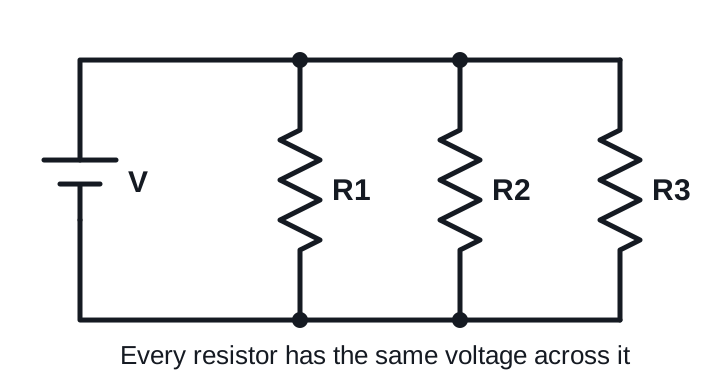
Parallel resistance formula
When resistors are connected in parallel, the current splits between them. Each extra path makes it easier for current to flow, so the total resistance goes down. Add up the reciprocals of each resistor, then take the reciprocal of that sum:
1 / Rtotal = 1 / R1 + 1 / R2 + 1 / R3 + …
For exactly two resistors there is a shortcut, often called “product over sum”:
Rtotal = (R1 × R2) / (R1 + R2)
Worked examples
Two different resistors
1 kΩ in parallel with 2.2 kΩ: (1,000 × 2,200) / (1,000 + 2,200) = 2,200,000 / 3,200 = 687.5 Ω.
Equal resistors
Identical resistors in parallel divide the value by how many there are. Two 10 kΩ resistors give 5 kΩ, and four 100 Ω resistors give 25 Ω. This is a common way to make an odd value, or to share the heat between several smaller parts.
Three resistors
100 Ω, 220 Ω and 470 Ω: 1/100 + 1/220 + 1/470 = 0.01 + 0.004545 + 0.002128 = 0.016673. The total is 1 / 0.016673 = 59.98 Ω.
Rules worth remembering
- The total is always smaller than the smallest resistor. If you get a bigger number, a reciprocal was missed.
- A very large resistor in parallel with a small one barely changes anything: 100 Ω in parallel with 1 MΩ is still 99.99 Ω.
- A 0 Ω link (or a short) in parallel takes all the current, and the total becomes 0 Ω.
- Every resistor in parallel has the same voltage across it. The current through each one is that voltage divided by its own resistance, and the smallest resistor carries the most current and gets the hottest. Check each part with the resistor power calculator.
Using parallel resistors to hit a value
Resistors are sold in standard values, so a value like 75 Ω or 2.35 kΩ may not be in your parts drawer. Putting a second resistor in parallel with a slightly higher one is a neat way to trim a value down. For example, 100 Ω in parallel with 300 Ω gives exactly 75 Ω. Two 4.7 kΩ resistors give 2.35 kΩ.
Need to add resistance instead? Resistors in series simply add up. Use the series resistor calculator, or read resistors in series and parallel explained for circuits that mix both.
Frequently asked questions
Does resistance increase or decrease in parallel?
It decreases. Every resistor you add in parallel gives the current another path, so the total is always lower than any single resistor.
How do I calculate two resistors in parallel quickly?
Multiply them, then divide by their sum. For 6 Ω and 3 Ω: 18 / 9 = 2 Ω.
What happens to the current in a parallel circuit?
The current from the source splits between the branches, and the branch currents add up to the total. Lower-value resistors take a bigger share.
More calculators
-
Resistor Color Code Calculator
Decode 3, 4, 5 and 6-band resistors, or find the bands for a value.
-
Series Resistor Calculator
Add up resistors in series, in any mix of units.
-
LED Resistor Calculator
Current-limiting resistor, standard value and wattage for LEDs.
-
Ohm's Law Calculator
Enter any two of voltage, current, resistance and power.
-
Voltage Divider Calculator
Output voltage, or the resistor needed for a target voltage.
-
Voltage Drop Calculator
Voltage across each resistor in a series circuit.
-
Resistor Power Calculator
Power dissipated in a resistor and the wattage rating to buy.
-
SMD Resistor Code Calculator
Decode 3-digit, 4-digit, R and EIA-96 SMD markings.
-
Standard Resistor Values
Nearest E6 to E192 value for any resistance.