Resistor Power Ratings Explained
Every resistor turns some electrical energy into heat. Its power rating, in watts, says how much heat it can get rid of without damage. Choose too small a rating and the resistor will drift, discolor or burn. This guide explains the numbers. The resistor power calculator works them out for you.
How to calculate the power
Use whichever version fits what you know:
P = V × I
P = I² × R
P = V² / R
Use the voltage across the resistor and the current through it, in volts and amps. The answer is in watts.
Examples
- A 330 Ω LED resistor carrying 10 mA: 0.01² × 330 = 0.033 W. Any resistor will do.
- A 47 Ω resistor with 5 V across it: 25 / 47 = 0.53 W. A 1/4 W resistor would overheat, and a 1 W part leaves less than the usual twofold margin. Use a 2 W part.
- A 0.1 Ω current-sense resistor carrying 3 A: 9 × 0.1 = 0.9 W, which needs a 2 W part.
What the rating really means
A datasheet rating such as 0.25 W applies in ideal conditions: usually in free air at an ambient temperature of 70 °C or less, mounted as the manufacturer intended. At full rated power, the body of a small resistor can reach well over 100 °C. That is within spec for the resistor, but hot enough to brown a circuit board and cook nearby capacitors.
Above the rated ambient temperature, the allowed power falls. A derating curve on the datasheet shows by how much, typically dropping to zero at around 155 °C for film resistors.
How much margin to leave
The common rule of thumb is to choose a resistor rated for at least twice the power it will dissipate. Use more margin when:
- the resistor is inside a closed box or near other hot parts;
- several warm resistors are packed close together;
- the circuit runs continuously, or must be very reliable.
Short pulses are a separate case. Many resistors can handle brief overloads far above their continuous rating, but the limits vary by type, so check the pulse rating on the datasheet.
Common ratings by size
| Type | Typical rating |
|---|---|
| 0402 / 0603 / 0805 / 1206 SMD | 1/16 W / 1/10 W / 1/8 W / 1/4 W |
| Through-hole, small (about 6 mm body) | 1/4 W |
| Through-hole, medium (about 9 mm body) | 1/2 W |
| Larger metal oxide or wirewound | 1 W to 5 W |
| Aluminum-housed power resistors | 10 W to 100 W and more, with a heat sink |
Size is only a rough guide. Modern metal-film parts can pack 1/2 W into a body that once held 1/4 W, so go by the datasheet or the seller’s listing.
Spreading the heat
If you need more power than one resistor can handle, use several. Two equal resistors in series or in parallel share the power equally:
- Two 200 Ω, 1/2 W resistors in parallel make 100 Ω at 1 W.
- Two 50 Ω, 1/2 W resistors in series also make 100 Ω at 1 W.
Use the series or parallel resistor calculator to check the combined value. Unequal values share power unequally, so check each one.
Signs of an overloaded resistor
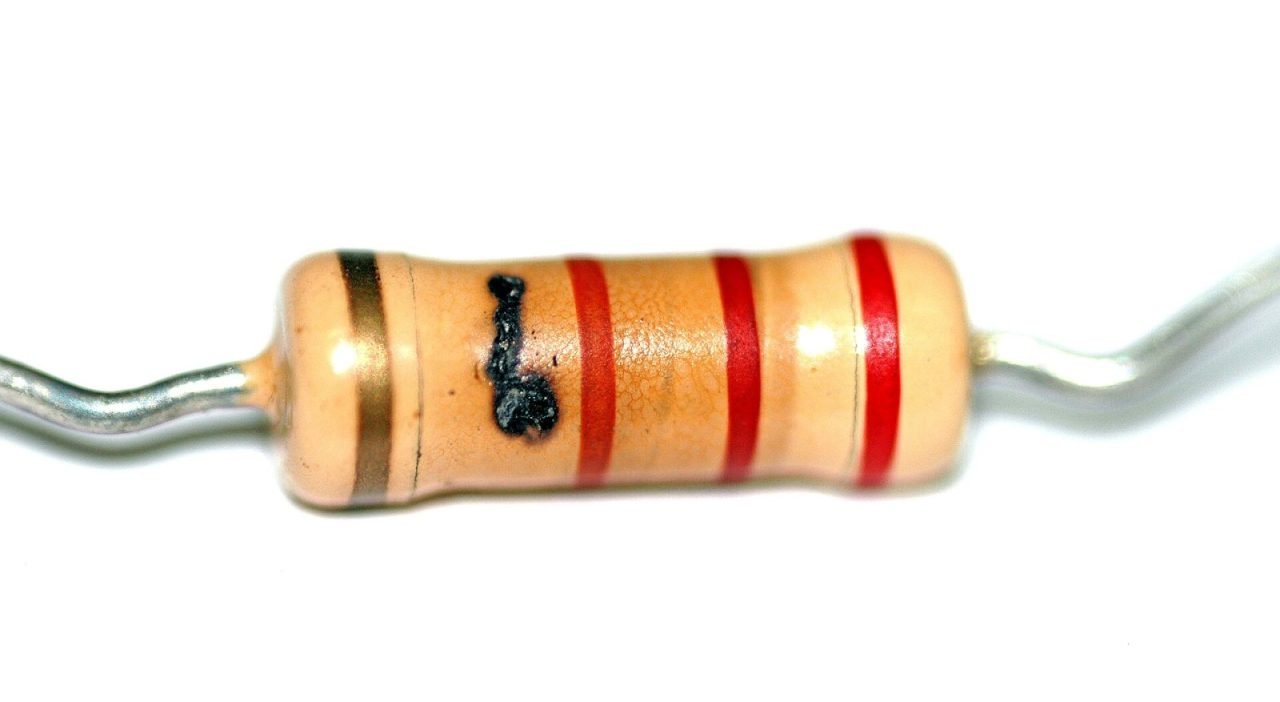
- Darkened, cracked or bubbled coating, or bands that are hard to read.
- A brown or black patch on the circuit board under or around the part.
- A burnt smell when the circuit is running.
- A value that measures well outside its tolerance.
An overheated resistor is usually a symptom, not the cause. Before replacing it, find out why it got hot: a shorted component further along is a common culprit, and a new resistor will just burn again.