How to Read Resistor Color Codes
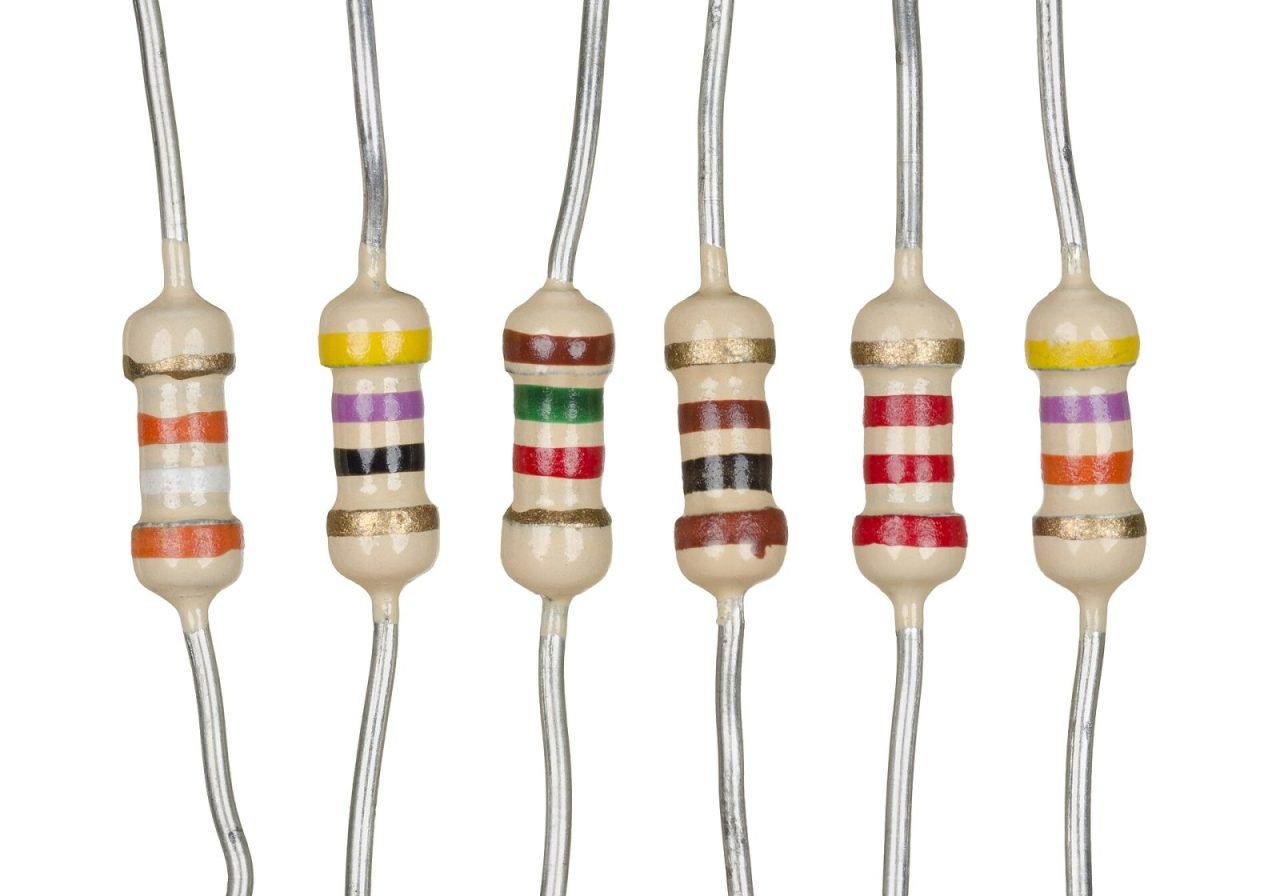
Most through-hole resistors are too small to print a number on, so their value is painted on as colored bands. Once you know the system, you can read most resistors in a few seconds. This guide walks through it step by step. If you just want the answer, the resistor color code calculator decodes any combination.
Step 1: Count the bands
Resistors have 3, 4, 5 or 6 bands:
- 4 bands (the most common): two digits, a multiplier and a tolerance.
- 5 bands: three digits, a multiplier and a tolerance. Found on precision (±1% and better) resistors.
- 6 bands: as 5 bands, plus a temperature coefficient.
- 3 bands: two digits and a multiplier, with no tolerance band (±20%).
Step 2: Find the first band
Turn the resistor so the tolerance band is on the right. Some clues help:
- The first band is usually closer to the end of the body.
- The tolerance band is often separated from the others by a wider gap.
- Gold and silver are almost always tolerance bands. They never appear as the first band.
- On a 4-band resistor, if one end is gold or silver, that is the right-hand end.
Step 3: Read the digits
Each color stands for a digit. The order follows the rainbow, with black and brown at the start and grey and white at the end:
| Color | Digit | Multiplier |
|---|---|---|
| Black | 0 | ×1 |
| Brown | 1 | ×10 |
| Red | 2 | ×100 |
| Orange | 3 | ×1,000 |
| Yellow | 4 | ×10,000 |
| Green | 5 | ×100,000 |
| Blue | 6 | ×1,000,000 |
| Violet | 7 | ×10,000,000 |
| Grey | 8 | ×100,000,000 |
| White | 9 | ×1,000,000,000 |
| Gold | – | ×0.1 |
| Silver | – | ×0.01 |
Write the digit bands down side by side. Yellow and violet give 47. On a 5-band resistor, brown, black and black give 100.
Step 4: Apply the multiplier
The band after the digits tells you what to multiply by. An easy way to think of it is the number of zeros to add: red is 2, so add two zeros. Yellow, violet, red gives 47 followed by 00, which is 4,700 Ω or 4.7 kΩ.
Gold and silver multipliers are for values under 10 Ω. Gold divides by 10 and silver by 100, so red, red, gold is 22 × 0.1 = 2.2 Ω.
Step 5: Read the tolerance
The last band (or the second-to-last on a 6-band resistor) says how far the real value may be from the marked value:
- Gold: ±5%
- Silver: ±10%
- Brown: ±1%
- Red: ±2%
- Green: ±0.5%, blue: ±0.25%, violet: ±0.1%
- No band: ±20%
A 4.7 kΩ ±5% resistor can measure anywhere from 4,465 Ω to 4,935 Ω and still be in spec.
Worked examples
- Brown, black, orange, gold: 1, 0, ×1,000, ±5% = 10 kΩ ±5%
- Red, red, brown, gold: 2, 2, ×10, ±5% = 220 Ω ±5%
- Orange, orange, brown, gold: 330 Ω ±5%, a classic LED resistor
- Brown, black, black, brown, brown: 1, 0, 0, ×10, ±1% = 1 kΩ ±1%
- Brown, green, black, silver, brown: 1, 5, 0, ×0.01, ±1% = 1.5 Ω ±1%
Common mistakes
- Reading from the wrong end. If your result is not a standard value, try reading it backwards.
- Mixing up similar colors. Brown, red and orange look alike under warm light, and so do violet and blue. Old resistors also fade and darken with heat.
- Confusing the body color with a band. Precision resistors often have blue or green bodies. The body color carries no meaning.
- Treating the multiplier as a digit. On a 4-band resistor, the third band is always the multiplier.
When in doubt, measure
Color blindness, faded paint or a scorched part can make bands impossible to read. A multimeter on its resistance (Ω) setting gives a definite answer. Take the resistor out of the circuit first, or at least lift one leg, because other parts connected in parallel will change the reading.
Surface-mount resistors use printed numbers instead of colors. See the SMD resistor code calculator for those.