How to Calculate Voltage Drop Across a Resistor
“How much voltage is across this resistor?” is one of the most common questions in electronics, and it comes down to one formula: Ohm’s law. This guide shows how to use it for a single resistor, for resistors in series and for parallel groups. The voltage drop calculator does the arithmetic for any series string.
The formula
The voltage across a resistor equals the current through it times its resistance:
V = I × R
Use amps and ohms to get volts. If you know the current is 15 mA and the resistor is 220 Ω, the voltage drop is 0.015 × 220 = 3.3 V.
The challenge is usually that you do not know the current yet. How you find it depends on how the circuit is connected.
One resistor across a supply
If a resistor is the only thing connected to a supply, the whole supply voltage is across it. A 1 kΩ resistor on a 9 V battery drops 9 V, and the current is 9 / 1,000 = 9 mA.
Resistors in series
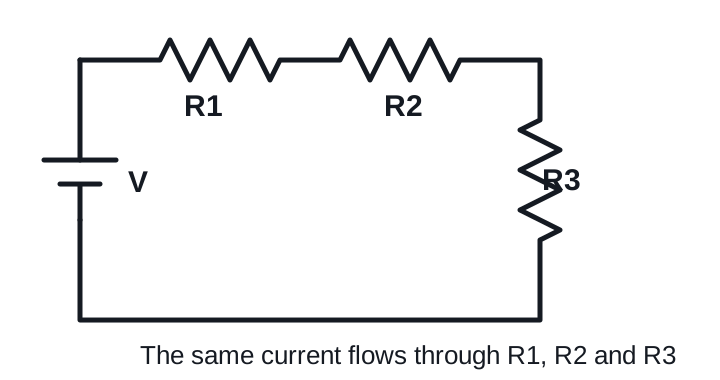
With several resistors in a single loop:
- Add the resistances to get the total. See the series resistor calculator.
- Find the current: I = Vsupply / Rtotal. It is the same through every resistor.
- Multiply the current by each resistor to get its voltage drop.
Example
A 9 V battery with 470 Ω, 1 kΩ and 2.2 kΩ in series:
- Rtotal = 470 + 1,000 + 2,200 = 3,670 Ω
- I = 9 / 3,670 = 2.452 mA
- V470 = 0.002452 × 470 = 1.15 V
- V1k = 0.002452 × 1,000 = 2.45 V
- V2.2k = 0.002452 × 2,200 = 5.40 V
Check: 1.15 + 2.45 + 5.40 = 9.00 V. The drops always add up to the supply voltage (Kirchhoff’s voltage law). If yours do not, something has gone wrong.
The ratio shortcut
Each resistor takes a share of the supply equal to its share of the total resistance: V1 = Vsupply × R1 / Rtotal. For two resistors this is the voltage divider formula.
Resistors in parallel
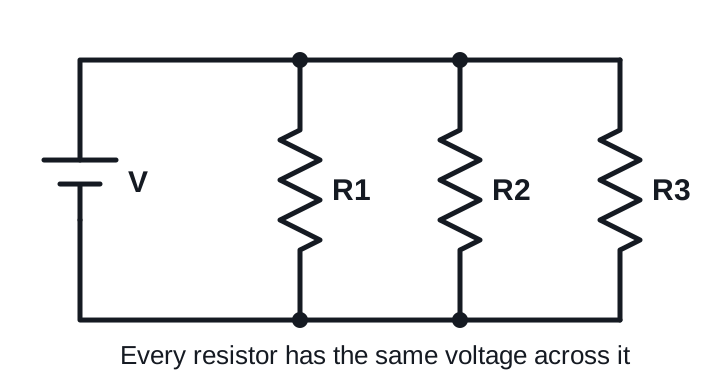
Resistors in parallel all have the same voltage across them, because they connect to the same two points. If a parallel group sits directly across a 12 V supply, every resistor in it drops 12 V.
If the group is part of a larger series circuit, replace it with its equivalent resistance (use the parallel resistor calculator), then treat it as one resistor in the series method above.
Example
A 12 V supply feeds a 1 kΩ resistor in series with two 2 kΩ resistors in parallel. The parallel pair is 1 kΩ, so the circuit is effectively 1 kΩ + 1 kΩ. The current is 12 / 2,000 = 6 mA. The single resistor drops 6 V, and each of the parallel resistors also drops 6 V, carrying 3 mA each.
When there are other components
LEDs and diodes do not follow Ohm’s law, but they have a fairly constant forward voltage. In an LED circuit, the resistor drops whatever the LED does not: VR = Vsupply − Vf. On 5 V with a 2 V red LED, the resistor drops 3 V. This is the basis of the LED resistor calculator.
Measuring the voltage drop
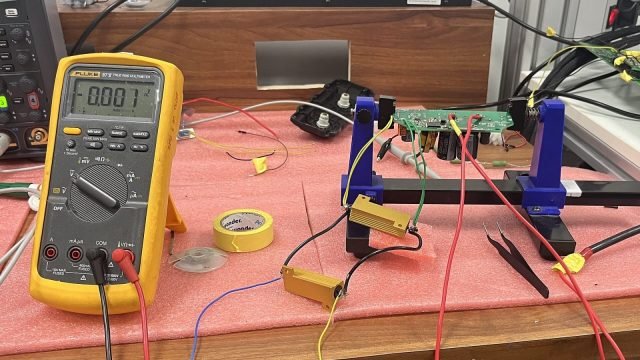
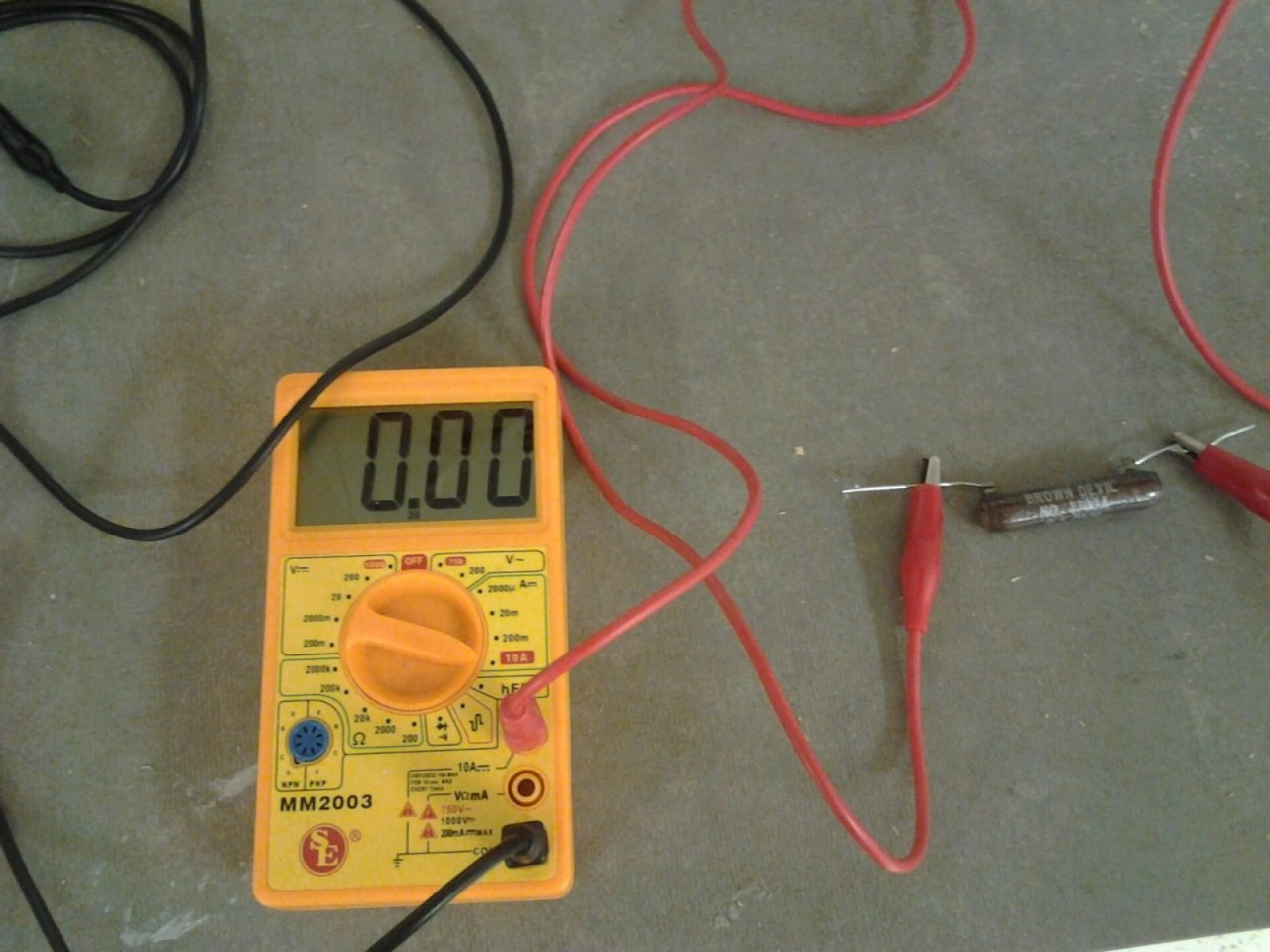
Set your multimeter to DC volts, power the circuit and touch the probes across the two ends of the resistor. Unlike measuring resistance, you can do this in circuit. A reading far from your calculation usually means a wrong part, a bad connection or a load you forgot to include.
Why voltage drop matters
The voltage drop also tells you how hot a resistor will get: P = V² / R. A 100 Ω resistor dropping 5 V dissipates 0.25 W, right at the limit of a common 1/4 W part. Check your parts with the resistor power calculator.