How to Calculate Current Through a Resistor
Knowing the current through a resistor tells you whether an LED will light, whether a microcontroller pin is overloaded and whether a part will overheat. The calculation is Ohm’s law again, applied in the right order. The Ohm’s law calculator handles the arithmetic.
The formula
I = V / R
Here V is the voltage across that resistor, not necessarily the supply voltage. Use volts and ohms and the answer is in amps. Multiply by 1,000 for milliamps.
For example, 5 V across 1 kΩ gives 5 / 1,000 = 0.005 A, or 5 mA.
A single resistor
If a resistor is connected directly across a supply, the full supply voltage is across it. 3.3 V across 10 kΩ gives 0.33 mA. 24 V across 100 Ω gives 240 mA, which also means 5.76 W of heat, far too much for a small resistor.
Resistors in series
In a series circuit, the current is the same through every resistor, so calculate it once for the whole string:
I = Vsupply / (R1 + R2 + R3 + …)
Example: 12 V across 1 kΩ, 2 kΩ and 3 kΩ in series. The total is 6 kΩ, so I = 12 / 6,000 = 2 mA through each resistor.
You can also start from one resistor: if you measure 4 V across the 2 kΩ resistor, the current is 4 / 2,000 = 2 mA, and the same 2 mA flows everywhere in the loop. The voltage drop calculator shows the current and every drop at once.
Resistors in parallel
In a parallel circuit, every resistor has the same voltage across it, but each takes its own current:
I1 = V / R1, I2 = V / R2, …
Itotal = I1 + I2 + …
Example: 9 V across 1 kΩ and 3 kΩ in parallel. I1 = 9 mA, I2 = 3 mA, and the battery supplies 12 mA in total. The smaller resistor takes the larger current. You can check this against the combined resistance: 1 kΩ in parallel with 3 kΩ is 750 Ω (try the parallel resistor calculator), and 9 / 750 = 12 mA.
The current divider rule
For two resistors in parallel, the current splits in the opposite ratio to their values. The current through R1 is Itotal × R2 / (R1 + R2). With 12 mA total, R1 = 1 kΩ and R2 = 3 kΩ: 12 × 3 / 4 = 9 mA through R1.
Mixed circuits
For series-parallel circuits, simplify step by step. Replace each parallel group with its equivalent resistance, add the series parts, and find the total current. Then work back outwards: find the voltage across each group, and the current through each resistor in it.
Measuring current
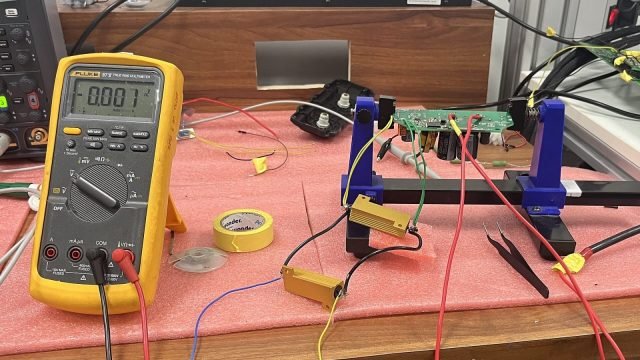
There are two ways to measure current with a multimeter.
- Directly: break the circuit and connect the meter in series, with the red lead in the current (A or mA) socket. Never connect a meter set to current straight across a supply. It acts as a near short circuit and will blow its fuse or worse.
- Indirectly (often easier): measure the voltage across a known resistor and divide by its resistance. 2.2 V across a 220 Ω resistor means 10 mA. Engineers use a low-value “shunt” resistor, such as 0.1 Ω, for exactly this.
Is the current safe?
Once you know the current, check the power with P = I² × R and compare it with the resistor’s rating, keeping a twofold margin. A 1/4 W, 220 Ω resistor can take up to about 34 mA, so 10 mA is comfortable. The resistor power calculator does this check for you.